Elite Steel
Choosing between stainless steel and aluminum can change a product’s weight, lifespan, and manufacturing cost. In China, both materials support extensive construction, machinery, transportation, and consumer product industries. What are the differences between stainless steel and aluminum? The answer depends on grade, thickness, surface treatment, and working conditions.
Stainless steel usually offers higher strength, better heat resistance, and a more durable surface. Aluminum provides lower density, easier handling, and strong natural corrosion protection. Weight matters. A stainless steel bracket may feel solid in the hand, while an aluminum panel can reduce equipment weight considerably. However, aluminum can lose strength at elevated temperatures. Stainless steel can also corrode when the wrong grade meets salt, chemicals, or poor maintenance.
This guide examines ten practical differences between stainless steel and aluminum. It considers strength, weight, corrosion behavior, conductivity, fabrication, appearance, cost, and recycling. It also discusses common Chinese grades, including 304 stainless steel, 316 stainless steel, and 6061 aluminum. These labels alone do not guarantee performance. Verified mill certificates, dimensional checks, and application testing remain important.
Specifications can be misleading.
A cheaper material may create higher long-term costs through repairs, coatings, or replacement. Supplier quality also varies, so buyers should compare test reports and relevant GB, ASTM, or EN requirements. There is no universal winner. Some choices remain debatable, especially when appearance and budget compete with durability. The following comparison aims to make those trade-offs clearer, while acknowledging that real projects require engineering review.
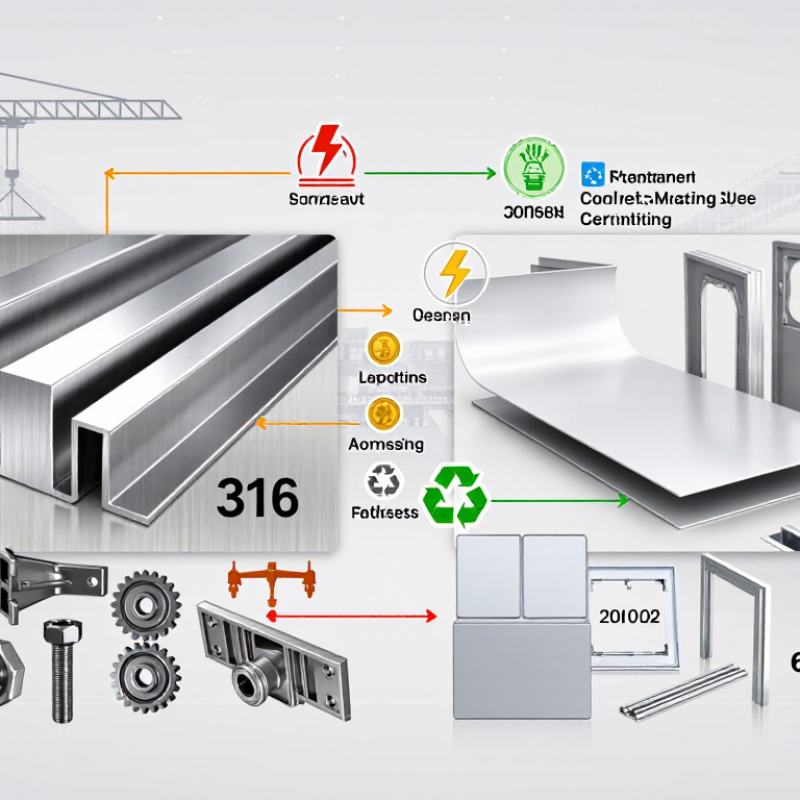
Stainless steel and aluminum begin with different material identities. Stainless steel is iron-based, with at least 10.5% chromium by mass. Nickel, molybdenum, manganese, and carbon adjust its performance. Chromium forms a thin, self-healing oxide film. That film protects the surface from many corrosive environments.
Aluminum is much lighter and mainly consists of aluminum, with smaller additions of magnesium, silicon, copper, zinc, or manganese. The International Aluminium Institute reported approximately 70 million metric tons of global primary aluminum production in 2023. Its face-centered cubic crystal structure supports good ductility and formability. Stainless steel may have face-centered cubic, body-centered cubic, or mixed structures. The grade and heat treatment decide the result.
This difference matters in real fabrication. A stainless sheet feels dense and rigid in the hand. An aluminum panel feels noticeably lighter, but it can dent more easily. The U.S. Geological Survey’s Mineral Commodity Summaries 2024 placed global stainless crude steel production near 60 million metric tons in 2023. That figure shows stainless steel’s broad industrial role, but production volume does not prove suitability.
A small correction is important. “Aluminum” is rarely pure in engineering products. “Stainless” is not rust-proof. Surface contamination, chloride exposure, poor welding, and trapped moisture can still cause problems. Material structure explains much, but design details often decide durability.
Stainless steel is roughly three times denser than aluminum. Typical densities are 7.9–8.0 and 2.7 g/cm³, respectively, according to ASM engineering property data. This makes aluminum easier to lift and transport. Stainless steel usually provides higher stiffness, with an elastic modulus near 193 GPa, compared with aluminum’s 69 GPa. It also resists dents better in many industrial applications. Yet alloy and temper matter greatly. A weak stainless grade can disappoint.
Strength is not the only difference. Aluminum conducts heat far better, about 205 W/m·K, while common austenitic stainless steel is near 16 W/m·K. Aluminum often machines faster, but stainless steel can offer better wear resistance and fire performance. Stainless steel is generally less magnetic in austenitic grades, while aluminum is nonmagnetic. Both can resist corrosion, though chloride exposure can cause pitting in stainless steel, while aluminum may develop surface oxidation. The International Aluminium Institute highlights aluminum’s strong recycling value, while World Steel Association data supports steel’s established recycling infrastructure.
Welding changes the decision. Aluminum needs careful heat control because it melts sooner and distorts easily. Stainless steel requires attention to heat input and contamination. Cost is also unstable. Energy prices, alloy content, thickness, and local supply can reverse the expected choice. The shortcut is imperfect. Engineers should test the exact grade, load, environment, and joining method before specifying either metal.
Corrosion resistance depends heavily on the environment, not only the material label. Stainless steel forms a chromium-rich passive film that protects its surface. However, salt, stagnant moisture, and poor cleaning can cause localized pitting. Aluminum quickly forms a thin oxide layer and performs well in ordinary air. Chloride exposure can still damage it, especially around scratches and joints. Dissimilar metal contact may create galvanic corrosion. That detail is often overlooked.
Heat performance creates a sharper difference. Aluminum transfers heat quickly, making it useful for heat sinks, cookware, and lightweight enclosures. It also expands more when temperatures change. Stainless steel conducts heat less efficiently but usually keeps its shape better under sustained heat. In fabrication, this can affect drilling, welding, and thermal distortion. Thin aluminum parts may feel hot almost immediately. Stainless surfaces feel slower to heat.
Surface appearance also changes with use. Brushed stainless steel hides small marks and gives a controlled industrial texture. Polished stainless steel shows fingerprints clearly. Aluminum can receive brushing, polishing, or anodizing, producing consistent colors and added surface hardness. Yet anodized finishes may reveal scratches permanently. A clean showroom sample can mislead. Real service conditions include dust, tools, water spots, and repeated handling. Testing a finished sample outdoors often reveals more than comparing catalog photographs.
China Top 10 Stainless Steel vs Aluminum Differences?
In China, stainless steel and aluminum follow different manufacturing routes. Stainless steel is commonly laser-cut, stamped, welded, or CNC-machined. Aluminum is often extruded, die-cast, rolled, or machined. Aluminum extrusion creates long profiles with consistent shapes. Stainless steel usually needs stronger tooling and slower cutting speeds. That affects production time.
Stainless steel suits kitchen equipment, medical structures, chemical containers, and outdoor parts requiring corrosion resistance. Aluminum fits vehicle components, lighting housings, frames, and portable equipment. It weighs less, transfers heat quickly, and is easier to machine in many cases. However, aluminum can dent more easily. Stainless steel can also show scratches, despite its durable surface. Small details matter.
Tips: Ask Chinese manufacturers for material certificates, thickness tolerance, weld samples, and surface-finish photos. Compare the same drawing and annual volume. A low material price may hide expensive tooling, polishing, or machining. Stainless steel often costs more per kilogram, while aluminum may reduce shipping expenses. Yet the final cost depends on alloy, order quantity, tooling, labor, finishing, and inspection. My practical view is imperfect: choosing only by price often creates rework later. A prototype may reveal distortion, sharp edges, or unexpected color differences before mass production.
Choosing between stainless steel and aluminum depends on the working environment, not appearance alone. Weight matters. Aluminum is about one-third as dense as stainless steel, making it useful for panels, transport frames, and movable equipment. Stainless steel usually provides higher strength, better impact resistance, and stronger protection against scratches.
Corrosion conditions deserve careful attention. Aluminum forms a protective oxide layer, but saltwater, alkaline cleaners, and contact with other metals can still cause problems. Stainless steel performs well in humid kitchens, outdoor structures, and sanitary equipment, especially when the correct grade is selected. Heat changes things. Aluminum transfers heat quickly, while stainless steel offers lower thermal conductivity and often better stiffness at elevated temperatures. Welding, bending, and surface finishing also affect the final cost.
A practical choice begins with measurements. Check the load, temperature range, cleaning chemicals, and expected service life. For a lightweight cover, aluminum may reduce handling effort and transport costs. For a heavily used support, stainless steel may prevent dents and repeated repairs. Yet stainless steel can become unnecessarily expensive or heavy when the design needs neither strength nor abrasion resistance. Galvanic corrosion is an easy detail to miss when aluminum touches stainless steel in a wet location. Electrical isolation, suitable fasteners, and drainage may be required. I would also request test samples when appearance matters, because brushed finishes and anodized surfaces can vary after fabrication.
This comparison uses representative values for 304 stainless steel and 6061-T6 aluminum. Aluminum is approximately one-third the density of stainless steel and conducts heat much more effectively, while 304 stainless steel generally provides higher tensile strength and greater stiffness. Actual properties vary by alloy, temper, product form, and manufacturing process.
Stainless steel is iron-based and contains at least 10.5% chromium. Aluminum is much lighter and mainly contains aluminum. Their different structures affect weight, stiffness, forming, and durability.
Aluminum is lighter. Its density is about 2.7 g/cm³, while stainless steel is about 7.9–8.0 g/cm³. A large aluminum panel feels easier to lift.
Stainless steel usually offers greater stiffness and dent resistance. Its elastic modulus is about 193 GPa, compared with aluminum’s 69 GPa. Alloy and temper still matter.
Aluminum transfers heat much more efficiently. Its thermal conductivity is about 205 W/m·K. Common austenitic stainless steel is near 16 W/m·K. That difference matters in housings and heat-transfer parts.
Both can resist corrosion, but neither is perfect. Stainless steel can suffer pitting in chloride environments. Aluminum forms surface oxidation, which may protect it. Trapped moisture still creates trouble.
Aluminum needs careful heat control because it melts sooner and can distort easily. Stainless steel also needs controlled heat and clean surfaces. Welding can change the original material choice.
Aluminum often machines faster and works well for extrusion and die-casting. Stainless steel commonly uses laser cutting, stamping, welding, or CNC machining. Stronger tooling may be needed for stainless steel.
Stainless steel often costs more per kilogram. Aluminum may reduce shipping costs because it weighs less. Tooling, finishing, labor, thickness, and order volume can reverse the expected result.
Request material certificates, thickness tolerances, weld samples, and surface-finish photographs. Compare identical drawings and quantities. A prototype may reveal distortion, sharp edges, or unexpected color differences.
No. Low material pricing can hide polishing, tooling, inspection, or rework costs. I have to admit the shortcut is imperfect. Test the exact grade, load, environment, and joining method.
This guide explains what are the differences between stainless steel and aluminum by comparing their composition, structure, and practical performance. Stainless steel is an iron-based alloy valued for its high strength, hardness, wear resistance, and long service life, while aluminum is a lightweight metal known for its low density, easy forming, and good strength-to-weight ratio. The article examines ten important differences, including weight, durability, corrosion resistance, heat performance, surface appearance, maintenance, and recyclability.
It also compares common manufacturing methods in China, such as cutting, stamping, welding, casting, and extrusion, while considering production efficiency and overall cost. Stainless steel may be preferred for demanding structural, high-temperature, or heavily used applications, whereas aluminum can be more suitable when weight reduction, convenient processing, or modern appearance is important. By reviewing typical applications and project requirements, readers can make a practical choice based on performance, environment, design, budget, and expected service life.
